
Shopify & E-commerce
Cash on Delivery for Shopify in Pakistan: How to Cut Fake Orders, Refusals and Returns in 2026
FynkTech Team, Lahore
111M
e-commerce transactions in FY25 (State Bank of Pakistan)
+42%
year-on-year growth in e-commerce transactions
~55%
estimated COD share of online orders (2026 seller guide)
TL;DR
COD builds trust for Shopify in Pakistan but drives fake orders and refusals. Confirm every order, validate addresses, reward prepayment, take advances on risky orders and route couriers by city to protect your margin.
Goals
- Reduce fake and refused COD orders
- Protect profit per delivered order
- Keep COD trust without the risk
- Rank and get cited for COD questions
Solutions
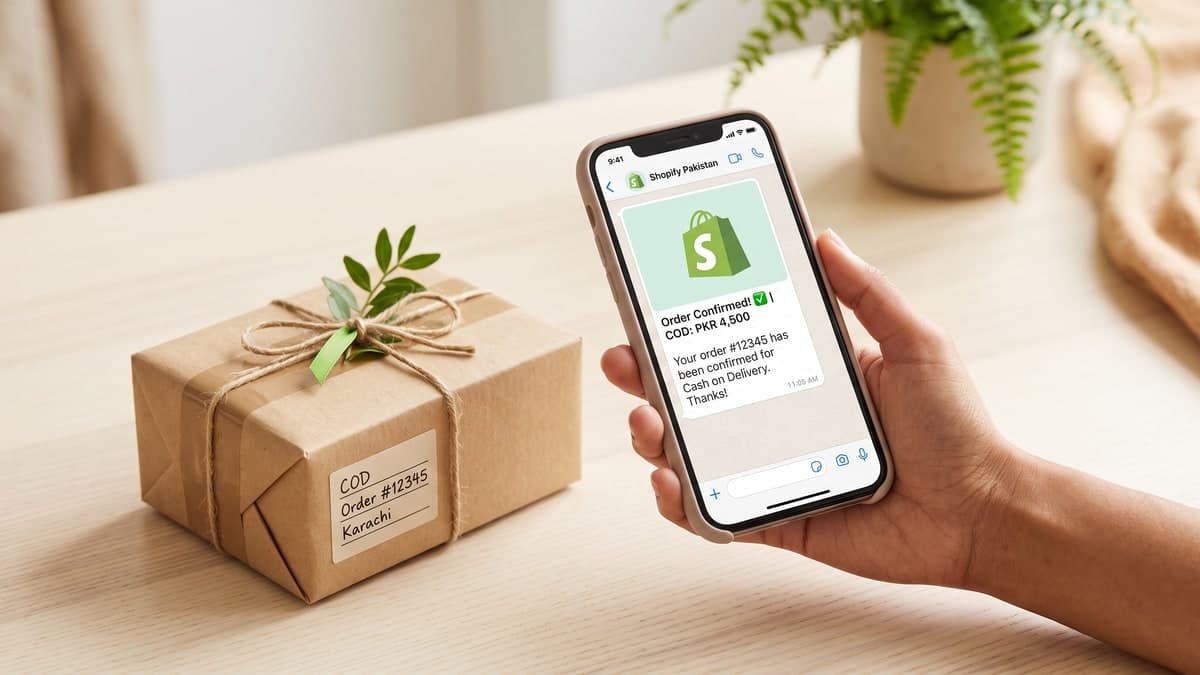
- WhatsApp and AI voice order confirmation
- Address validation and COD limits
- Prepaid incentives and partial advances
- COD policy and FAQ with structured data
Cash on Delivery for Shopify in
Pakistan: How to Cut Fake Orders, Refusals and Returns in 2026
By the FynkTech Team | Updated October 2026 |
Reading time: about 10 minutes
| Part of our Shopify in Pakistan
content series
|
Quick answer Cash on Delivery (COD) is the
most trusted payment method for Shopify in Pakistan, but it also causes most
of the refused parcels and fake orders. You can keep COD and still protect
margin by confirming every order by WhatsApp or call, validating addresses,
offering a small prepaid discount, taking an advance on high-value items,
routing parcels through the best courier for each city and tracking refusal
rates by product and area. |
Introduction: COD Is a Growth Tool
and a Profit Risk
Ask any founder
running Shopify in Pakistan what keeps them awake, and Cash on Delivery will be
near the top of the list. Customers love it because they pay only when the
parcel is in their hands. Merchants love it because it removes the biggest
trust barrier for first-time buyers. Then the refusals arrive, courier fees
pile up, and a healthy-looking sales dashboard hides a thin or negative margin.
This article is
a focused companion to our complete guide to Shopify in Pakistan. It
explains why COD dominates, what it really costs, and a practical system to
reduce fake orders and returns without losing the customers who depend on it.
You will find a worked cost example, a ten-step playbook, automation ideas and
a short FAQ.
Why Cash on Delivery Dominates Online
Shopping in Pakistan
COD persists
because of trust, access and habit. Many shoppers have been disappointed by
late or fake online stores, so paying on arrival feels safe. Card ownership is
limited, and although mobile wallets and bank apps are growing, not everyone is
comfortable using them online. Industry estimates of COD's share of e-commerce
orders vary. One 2026 seller guide puts it at around 55 percent of
transactions, with wallets such as Easypaisa and JazzCash at roughly 20
percent. Treat such figures as directional, because they depend on category,
city and how each source defines e-commerce.
What is clear
is that digital activity is rising fast. The State Bank of Pakistan reported
111 million e-commerce transactions in FY25, up from 78 million the year
before, a jump of about 42 percent. As more people pay digitally, COD will
shrink as a share of orders, but for most stores it will remain essential for
years. The sensible strategy is to manage it well rather than fight it.
What COD Really Costs: A Worked
Example
Many merchants
judge COD by the revenue it brings, not the cost it creates. The numbers below
are illustrative, so replace them with your own, but the pattern is typical.
|
Item (illustrative, per
order) |
Delivered order |
Refused order |
|
Selling price |
PKR 4,000 |
PKR 0 |
|
Product cost |
PKR 1,800 |
PKR 0 (stock returns later) |
|
Outbound courier fee |
PKR 300 |
PKR 300 |
|
Return courier fee |
PKR 0 |
PKR 300 |
|
COD handling and packaging |
PKR 200 |
PKR 100 |
|
Advertising cost to win the
order |
PKR 600 |
PKR 600 |
|
Result |
+PKR 1,100 profit |
-PKR 1,300 loss |
In this
example, one refused parcel erases the profit of more than one delivered order.
If 20 percent of your orders are refused, your average profit per order falls
from PKR 1,100 to about PKR 620, a drop of roughly 44 percent. At a refusal
rate near 46 percent, the store breaks even. Every percentage point you recover
goes straight to the bottom line, which makes COD management one of the
highest-return projects in your business.
Why Fake and Refused COD Orders
Happen
•
Impulse buying: a social media ad triggers an
order, and the buyer changes their mind before delivery.
•
Wrong or incomplete addresses: couriers cannot
find the customer, so the parcel fails.
•
Fake or prank orders: wrong phone numbers,
competitor tests or deliberate abuse.
•
Price shock: the delivery fee or total is higher
than expected at the door.
•
Long delivery times: the customer loses interest
or buys elsewhere while waiting.
•
Sizing and expectation gaps: especially in
fashion, where customers order several sizes and refuse the rest.
Notice that
most causes can be addressed before dispatch. That is where your effort should
focus.
A Ten-Step Playbook to Reduce COD
Fake Orders and Returns
1. Confirm every order before
shipping
Confirmation is
the single most effective control. Send a WhatsApp message or make a short
automated call within an hour of the order, ask the customer to confirm the
product, size, address and total, and ship only after a positive reply. Orders
with no response after two attempts should be held or cancelled.
2. Validate phone numbers and
addresses at checkout
Require a
working mobile number, a full address with a nearby landmark and the city from
a dropdown list. Flag orders with missing house numbers, repeated characters or
numbers that fail basic format checks. Clean data at checkout saves failed
deliveries later.
3. Offer a prepaid incentive
A small
discount or free shipping for paying by wallet, bank transfer or card moves
price-sensitive but trusted customers away from COD. Even a modest shift in
payment mix lowers your refusal rate because prepaid customers rarely refuse.
4. Take an advance on high-value or
custom orders
For expensive,
personalized or limited-stock items, collect a partial advance, for example 20
to 30 percent, and the balance on delivery. The advance proves intent and
covers your freight if the order fails.
5. Set COD limits for new customers
Cap COD order
value for first-time buyers in high-risk areas, and lift the cap after one
successful delivery. Returning customers with a clean history can enjoy higher
limits.
6. Add a transparent COD fee where
appropriate
A small,
clearly displayed COD handling fee discourages casual ordering and offsets
courier charges. Show it early in the cart, because surprises at the final step
cause abandonment.
7. Choose couriers by city
performance
Do not assume
one courier works everywhere. Track delivery success, refusal handling and cash
settlement time by courier and city, then route accordingly. Our guide to operations and automation for e-commerce explains
how stores build this routing logic.
8. Keep customers informed after
dispatch
Send tracking
links and delivery-day reminders by SMS or WhatsApp. A customer who knows when
to expect the parcel and has the right cash ready is far less likely to refuse
it.
9. Build a risk list
Record phone
numbers, addresses and areas linked to repeated refusals. Tag them in Shopify
and apply stricter rules, such as mandatory prepayment. Review the list monthly
so genuine customers are not blocked unfairly.
10. Close the loop with policies and
feedback
Publish a clear
COD, return and exchange policy. When a parcel is refused, record the reason,
because patterns by product, price point or ad campaign reveal fixable
problems. A weak product page or misleading creative often hides behind a high
refusal rate.
Quick Reference: COD Control Tactics
Compared
|
Tactic |
What it does |
Effort to set up |
|
WhatsApp or call
confirmation |
Removes fake and impulse
orders before dispatch |
Low to medium; easy to
automate |
|
Address validation |
Prevents failed deliveries |
Low |
|
Prepaid discount |
Shifts customers to digital
payment |
Low |
|
Partial advance |
Secures freight cost on
risky orders |
Medium |
|
COD limits for new buyers |
Caps exposure to unknown
customers |
Low |
|
Courier routing |
Improves success by city |
Medium |
|
Risk list and tagging |
Blocks repeat offenders |
Medium |
Setting Up COD Controls on Shopify
Shopify lets
you add a manual payment method for Cash on Delivery from your payment
settings, and you can adjust delivery rates by zone. Beyond the basics, use
order tags such as confirmed, unconfirmed, high-risk and prepaid, so that your
team and your automations know what to do with each order. Check your plan's
features and available apps for workflow tools, because capabilities change
over time.
Your checkout
and product pages matter just as much as your settings. A clear price, delivery
estimate and return summary reduce price shock and regret. If you want an
expert review of your checkout flow, FynkTech's store
setup and development team can audit it, and our article on Shopify stores built to convert lists the trust
elements that lower refusals.
Automating COD Confirmation with AI
and Workflows
Manual
confirmation works at ten orders a day and breaks at a hundred. Automation lets
you keep the human touch where it counts and remove repetitive work everywhere
else.
•
Trigger: a new COD order arrives in Shopify.
•
Action: an automated message or call asks the
customer to confirm details.
•
Outcome: confirmed orders go straight to the
courier, unconfirmed ones go to a follow-up queue, and rejected ones are
cancelled with the reason recorded.
•
Reporting: a dashboard shows confirmation rate,
refusals and cash outstanding by courier.
This is exactly
what AI voice and chat automation is built for:
answering common questions, confirming orders and passing complex cases to your
team. Behind the scenes, workflow
automation connects Shopify, couriers and your messaging tools, and custom AI agents can apply your own risk rules.
Our piece on how workflow automation cuts busywork shows where the
time savings come from. Before you invest, estimate the payback with our ROI
calculator.
Measure What Matters: COD KPIs
|
KPI |
How to calculate it |
Target direction |
|
Confirmation rate |
Confirmed orders divided by
total COD orders |
Rising |
|
Refusal rate |
Refused parcels divided by
dispatched COD parcels |
Falling |
|
Delivery success by courier |
Delivered divided by
dispatched, per city |
Rising |
|
Prepaid share |
Prepaid orders divided by
all orders |
Rising gradually |
|
Net profit per order |
Profit after all freight,
fees and ads |
Rising |
Review these
weekly, and connect them to your acquisition data. When a campaign brings high
sales but also high refusals, its true return is lower than the ad dashboard
suggests. Better data analytics and scaling systems make that
visible, and stronger sales funnel optimization reduces the impulse
orders that turn into refusals.
SEO, AEO and GEO Tips for Your COD
Content
Customers and
AI assistants both search for COD answers, so publish them. Create a
plain-language COD policy page and a FAQ that answers questions such as
"Do you offer Cash on Delivery?", "Is there a COD fee?" and
"How do I return a COD order?". Put the direct answer in the first
sentence, use short paragraphs and add FAQ structured data. These steps help
your pages win featured answers (AEO), rank for long-tail searches (SEO) and
become a reliable source for AI tools (GEO).
Support the
page with original data, such as your own confirmation rate or average delivery
times by city, and show the date it was last updated. Specific, verifiable
facts are far more likely to be cited. For wider promotion tactics, see our marketing and growth systems overview.
Frequently Asked Questions About COD
on Shopify in Pakistan
Should I stop offering Cash on
Delivery?
Usually not.
COD builds trust and drives first orders. Keep it, but add confirmation,
address checks and incentives for prepayment so that it stays profitable.
What is a good COD refusal rate?
It varies by
category, city and price point, so there is no universal benchmark. Measure
your own baseline, then aim to reduce it steadily. Fashion with multiple-size
orders usually runs higher than single-item products.
How do I stop fake COD orders on Shopify?
Confirm each
order by WhatsApp or call before shipping, validate phone numbers and addresses
at checkout, cap COD for new customers and tag repeat offenders for stricter
rules.
Is a COD fee legal and acceptable to
customers?
A small,
transparent handling fee is common among online sellers. Display it clearly
before checkout, and check consumer and tax guidance with a qualified adviser
for your situation.
Can I accept partial advance
payments?
Yes. Many
sellers collect a deposit through bank transfer or a wallet and take the
balance on delivery. This works especially well for custom or high-value items.
Conclusion: Keep COD, Control the
Risk
Cash on
Delivery will remain part of Shopify in Pakistan for the foreseeable future.
The merchants who thrive are not the ones who eliminate it, but the ones who
confirm orders, clean their data, reward prepayment, choose couriers wisely and
measure outcomes. Start with confirmation and address validation, then layer on
the rest.
Ready to protect
your margins? Read the full Shopify in Pakistan guide, review our case
studies, or contact FynkTech to set up automated COD
confirmation for your store. You can also explore our wider e-commerce
solutions.
Sources referenced: State Bank of Pakistan Annual Payment Systems Review
as reported by Markaz; a 2026 seller guide on selling on Shopify in Pakistan
for COD and wallet share estimates. Cost figures in the worked example are
illustrative. Verify current platform features, courier terms and tax rules
before acting.
“A refused COD parcel can erase the profit of more than one delivered order. Confirmation is the cheapest margin you will ever recover.”
Want results like this for your team?
Talk to FynkTech about AI agents and automation.
Book a free consultation

